
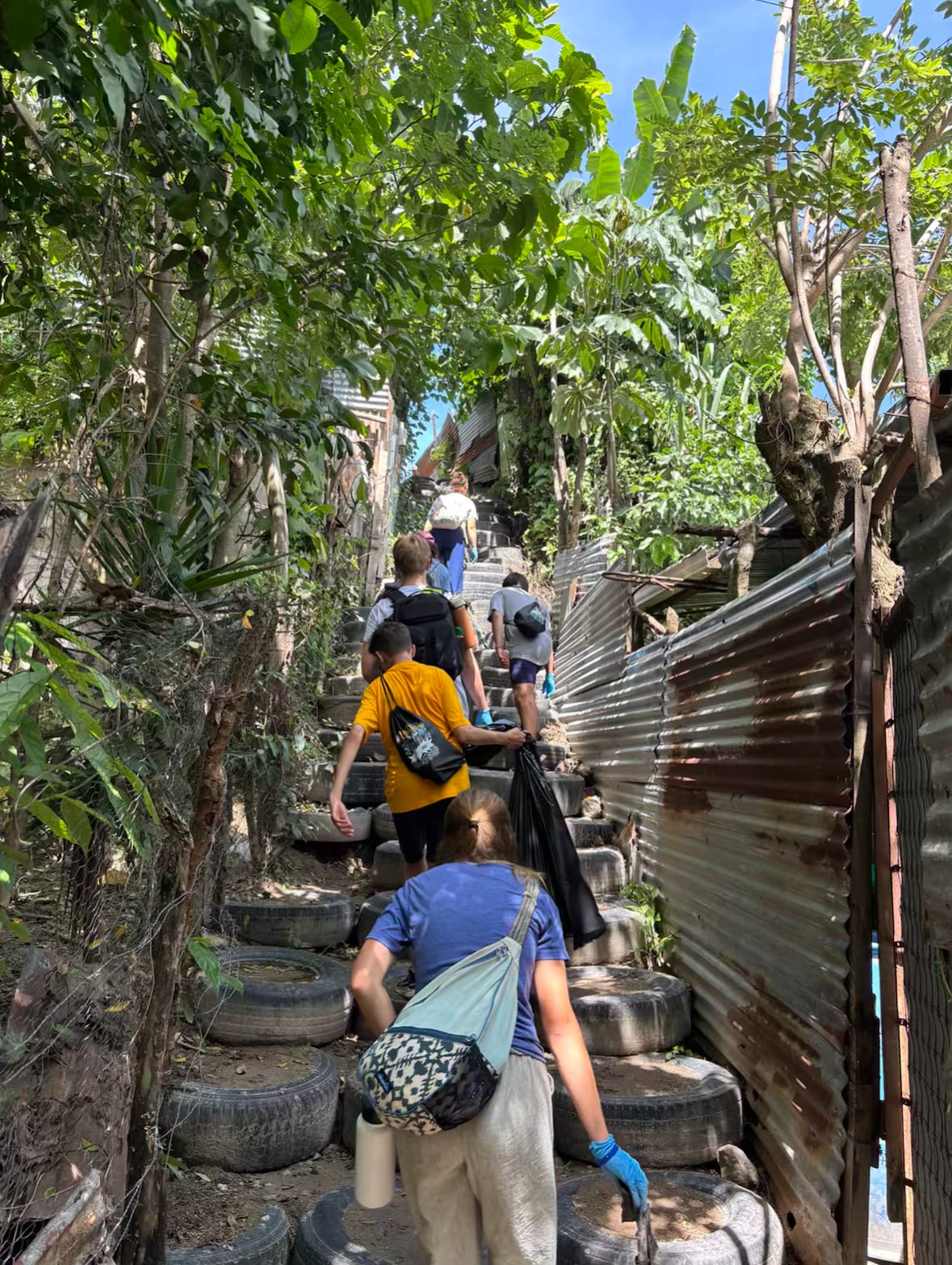
During our Students Living a Mission youth week in El Salvador, we had the opportunity to lead a group of 110 people—including leaders, Salvadoran youth, Salvadoran translators, and SI interns—into a slum community in Suchitoto called Milagro de Dios. This community is located next to the wealthier areas of Suchitoto, where runoff from rain and storms channels trash and sewage into the valley below, directly affecting this low-lying neighborhood.
Our team walked the streets of Milagro de Dios, picking up trash, glass, metal, and debris. We walked down dirt paths lined with makeshift homes—structures made of tin and wood beams—and along paths that dropped off below, with steep steps made from dilapidated tires and packed sand. Along the way, we had the opportunity to talk with and visit members of the community. Though this area looked rough —dehumanizing even—it was full of beautiful people.
As I walked down one sandy path and knelt to pick up shards of glass I had nearly stepped on, I watched a young girl—maybe around 7 years old—run barefoot up a steep incline of tires that led to the road above. I couldn’t help but bring what I was seeing and feeling to God in prayer as I walked.
Then, I heard a group of four of our youth singing “La Montaña” with a few community members who had come out to greet them. One of the Spanish lines in the song says, “La montaña se moverá, moverá, moverá”—“The mountain will move, move, move.” I listened to it being sung with such faith, surrounded by such a painfully unfair environment and conditions, and was touched by the reality that even in the midst of suffering and brokenness, faith makes room to sing with confidence in the power of God to overcome any obstacle—to move those “mountains,” like poverty, that seem impossible to solve or bring a solution to.
I watched as our team carried heavy bags full of trash and debris out of the community. Some of them had tear-streaked faces; others were beaming after greeting precious community members on our walk out. I was humbled. Humbled to walk these streets. Humbled to serve this community. And humbled to know the Lord who, just as He heard Israel when they cried out to Him in Egypt, hears the cries of the poor and marginalized like those we encountered that day. He hears. He sees. He responds.
As we now prepare to travel to Uganda and Kenya, I’m reflecting on this response: Hear. See. Respond.
There’s so much we ignore, so much we shut our eyes to, so much we refuse to act on. But God responds with justice and compassion.
I’ve often thought it would’ve been easier if God had simply picked Israel up and set them directly in the Promised Land the moment they cried out in suffering. But instead, He chose to call Moses—and many others down the line—to be the vessels through which He would respond to injustice and pain in the world.
In the same way, God has called me—and this team—to be His hands and feet, His response to the suffering we encounter this summer.
My prayer is that, just as God showed His presence and light in Milagro de Dios, He would continue to use us as His response to meet the needs of the poor. May we show people that God hears them, that He sees them, that He has compassion—and that He loves them enough to respond.